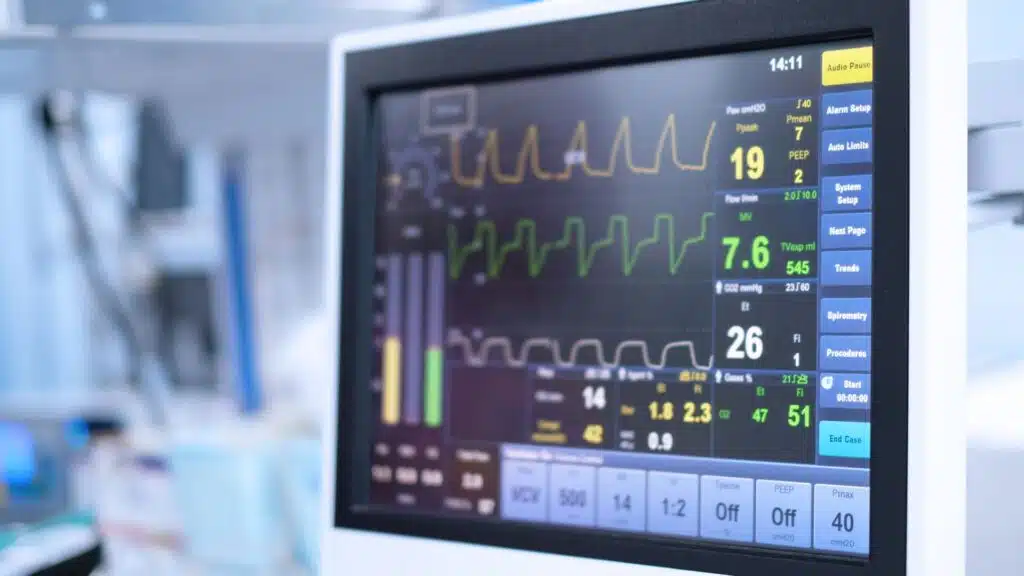

Tracheostomy & Ventilator Management
A tracheostomy and a ventilator can feel like foreign objects at first: tubes, machines, and sounds that take over a...

Locked-in syndrome strips away nearly every means of physical expression while leaving the mind fully intact, which is a profound and isolating condition for patients, families, and caregivers alike. Assistive technology bridges this gap, transforming isolated awareness into active participation. For patients, it restores voice, choice, and dignity. For families, it enables genuine connection. For caregivers, it provides tools that make sustainable, responsive care possible. In this context, assistive technology is not optional; it is essential.

Legally Reviewed By
Attorney Rich Newsome
Catastrophic Injury & Medical Malpractice Attorney
25+ years experience

For patients with locked-in syndrome, the ability to communicate is transformative. AAC technologies make this possible across a spectrum of capabilities and needs.
For patients with locked-in syndrome, the ability to influence their immediate environment, independently and reliably, is fundamental to autonomy and well-being. Modern environmental control systems (ECS) integrate with everyday infrastructure to place that control within reach.
Smart home platforms, such as Google Home and Amazon Alexa, when paired with accessible interfaces, allow patients to control lights, temperature, televisions, door locks, and window blinds through minimal input. These systems reduce dependency on caregivers for routine adjustments, preserving patient dignity and caregiver capacity.
Standard voice assistants can be adapted for LIS patients using breath-switch input or eye-gaze triggers. These adaptations allow patients to issue commands without conventional speech, enabling them to interact with their environment.
Dedicated emergency alert systems, triggered by eye gaze or breath, provide patients with the ability to summon help independently. This capability is essential for safety and profoundly impacts patients’ and caregivers’ peace of mind.
While communication often takes priority in early LIS care, physical mobility and rehabilitation support are equally vital to long-term wellbeing, injury prevention, and quality of life.
Advanced powered wheelchairs equipped with eye-gaze technology allow patients to navigate their environment independently, translating gaze direction into movement commands. This capability meaningfully restores freedom of movement and reduces full reliance on caregivers for transport.
Robotic exoskeletons and FES systems deliver controlled electrical impulses to paralyzed muscles, facilitating assisted movement and helping maintain muscle integrity, circulation, and joint health, reducing long-term complications of immobility. These systems are still in their infancy.
Automated pressure-relief mattresses and positioning systems reduce the risk of pressure injuries, one of the most serious and preventable complications in LIS care.
Robotic arms and assistive devices, controlled via gaze or BCI, support patients in performing basic daily activities such as eating, grooming, and object manipulation, extending functional independence beyond communication alone.
Of all assistive technologies available to patients with locked-in syndrome, BCIs represent the most transformative and most complex frontier, offering the possibility of direct communication and control through thought alone.
EEG-based BCIs capture electrical brain activity through scalp electrodes, offering a safe, accessible option, though with limitations in signal resolution and speed. Invasive systems, by contrast, use surgically implanted electrode arrays, such as electrocorticography (ECoG) or intracortical microelectrode arrays, positioned directly on or within the cortex, yielding significantly richer and more precise neural signals.
The BrainGate consortium has pioneered intracortical BCI research, demonstrating that implanted arrays could enable LIS patients to use text and text-to-speech capabilities, according to Neurorehabilitation and Neural Repair.
BCIs have enabled patients to use tablets “all by just thinking about pointing and clicking a mouse,” according to Brown University’s School of Engineering.
Significant challenges remain in implementing BCI technology for people with LIS. EEG signals are vulnerable to noise and artifacts. Implanted devices carry surgical risks, including infection and hemorrhage. Long-term signal stability is compromised by glial scarring around electrodes, degrading performance over time.
Despite remarkable technological advances, assistive technology remains out of reach for many patients with locked-in syndrome.
The technologies described in this guide can carry significant costs. Eye-tracking communication systems often run into the tens of thousands of dollars. Brain-computer interfaces, powered wheelchairs, and robotic assistance devices can cost considerably more, and insurance coverage remains inconsistent and incomplete. For many families, the gap between what is medically necessary and what is financially accessible is a painful one.
If your loved one’s locked-in syndrome was caused by a stroke, it may be worth exploring whether that outcome resulted from medical negligence, such as a delayed diagnosis, a surgical error, a failure to diagnose, or a failure to follow established standards of care. If it did, a legal claim may be one path toward recovering the compensation needed to fund long-term assistive technology, ongoing care, and rehabilitation support.
We can help you understand whether that option may apply to your situation. An initial conversation is free, confidential, and carries no obligation; it is simply a chance to get informed.
If a delayed diagnosis led to permanent harm, you may be entitled to compensation. Speak with our legal team today.
Start My Free Case Review
Locked-in syndrome presents one of the most profound challenges a person and their family can face. But the landscape of assistive technology has transformed what is possible for people living with this condition. Communication, environmental control, mobility, and meaningful daily participation are no longer out of reach.
The locked-in syndrome attorneys at Newsome Law are here to help you explore potential options for covering the costs of these technologies. Reach out whenever you are ready. Once we’ve heard your story, we can perform a medical review to establish how this happened and what your options are.
A tracheostomy and a ventilator can feel like foreign objects at first: tubes, machines, and sounds that take over a...

Locked-in syndrome (LIS) changes everything overnight, including a family's finances. Once income stops, Social Security disability benefits can become a...

Learning your child has locked-in syndrome can feel like standing in a room with no map. It's a rare diagnosis,...

While there are occasional cases that make the news of someone recovering from locked-in syndrome or a similar diagnosis, this...

The area of the brain that can cause locked-in syndrome (the pons) following a stroke is the same area of...

Because it causes near-global paralysis, takes away the ability to speak, and prevents a person from providing self-care, locked-in syndrome...

Locked-in syndrome occurs when an injury to the brainstem prevents the brain from communicating with the spinal cord and the...
Some people diagnosed with locked-in syndrome continue to feel pain and retain sensation throughout their body or in limited areas...