

Medication Errors Leading to Brainstem Hemorrhage
Most people think of medication errors as something small. A missed pill. A mix-up at the pharmacy counter. But some...


Legally Reviewed By
Attorney Rich Newsome
Catastrophic Injury & Medical Malpractice Attorney
25+ years experience

Some brain conditions don’t come from an injury or a stroke. They come from something that happens inside the body’s own chemistry. Central pontine myelinolysis, or CPM, is one of these. It’s a rare disorder that harms nerve tissue in a specific part of the brainstem. In its worst form, it can leave a person fully locked inside their own body, aware but unable to move or speak. Doctors sometimes use another name for this condition: osmotic demyelination syndrome.
Below, we discuss how CPM develops, why it can trigger locked-in syndrome, and what current research says about recovery.
Before getting into CPM itself, it helps to know where the damage happens. The pons sits in the brainstem, right between the spinal cord and the upper brain. Think of it as a relay station; it passes signals back and forth and helps keep basic survival functions running, like breathing and heartbeat.
Nerve fibers throughout the brain are wrapped in a substance called myelin. Myelin works like the insulation around an electrical wire. It helps nerve cells send signals quickly and clearly. When that sheath is stripped away or damaged, signals slow down or stop getting through.
CPM traces back to something surprising: the body’s sodium balance. Nerve cells depend on a delicate mix of salt and water to function. If sodium in the bloodstream climbs too quickly, water gets pulled out of nearby brain cells. Losing that water leaves the cells shrunken and damaged, and the myelin coating around them suffers the same fate. Cells in the pons appear to be unusually vulnerable to this kind of rapid shift.
This rapid sodium rise usually happens during medical treatment for sodium that is too low, a condition doctors call hyponatremia. IV fluids used to correct low sodium can sometimes push levels up faster than the brain can safely adjust to.
Several health situations make this more likely to occur:
Locked-in syndrome happens specifically because of damage to certain nerve pathways that carry movement signals, pathways that run straight through the pons on their way down to the spinal cord. CPM, because it affects the pons itself, can cause this damage. EPM cannot. EPM, or extrapontine myelinolysis, affects structures outside of the pons.
However, it is important to note that both CPM and EPM can occur together. So while EPM does not cause locked-in syndrome, it can occur alongside a condition that does. According to the Cleveland Clinic, “EPM rarely occurs without CPM.”
Not everyone with CPM ends up with the same outcome. Some people barely notice anything is wrong. Others become critically ill.
Medical case reports describe a troubling pattern: a patient is treated for dangerously low sodium and appears to be improving, only to develop new, unexpected symptoms later. Weakness sets in and can spread rapidly through the body. In the most severe cases, nearly every voluntary muscle stops responding, except the muscles controlling the eyes. That’s locked-in syndrome: full mental awareness trapped inside a body that will no longer obey commands, with eye movement sometimes the only channel left for communication.
Diagnosing CPM isn’t always straightforward. A physician will typically:
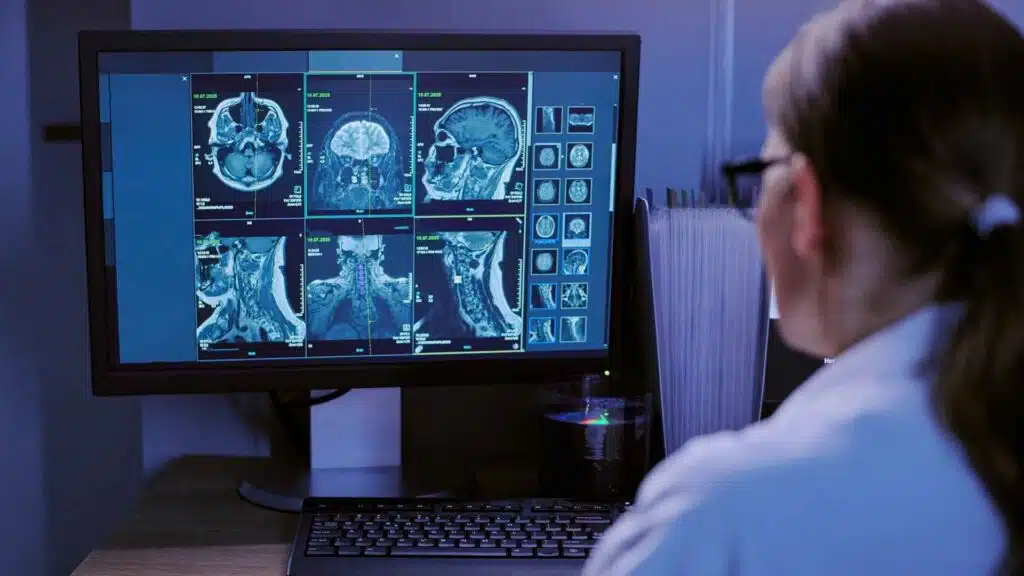
The MRI is meant to reveal lesions, i.e., visible signs of damage, in the affected brain tissue. But there’s a catch: those lesions don’t always appear right away. In some cases, it can take up to two weeks after symptoms start before an MRI shows anything unusual, which can delay a definitive diagnosis, according to the Cleveland Clinic.
There isn’t a cure that reverses CPM once it has occurred. Care instead centers on addressing whatever symptoms show up.
Rehabilitation tends to play the biggest role in long-term outcomes. Case reports published in the Annals of Rehabilitation Medicine and Annals of Clinical and Translational Neurology consistently point to early and intensive therapy as a meaningful factor in how well someone recovers from CPM-related locked-in syndrome.
Decades ago, CPM had a grim reputation. Early medical literature described it as frequently fatal within a short window after diagnosis. That picture has shifted considerably. Faster recognition of the condition and stronger critical-care support have changed the odds.
Current figures tell a more hopeful story:
Individual case studies illustrate just how much recovery is possible. One documented patient started out completely paralyzed from locked-in syndrome caused by CPM and, after more than two years of continued rehabilitation, regained the ability to walk with supervision (Ann. Rehab Med). In a separate study following two patients with the same diagnosis, both began showing steady improvement within two to three months of symptom onset. By the one-year mark, each had regained a substantial amount of independence and physical strength (Ann. Clin. Transl. Neurol.)
If a delayed diagnosis led to permanent harm, you may be entitled to compensation. Speak with our legal team today.
Start My Free Case Review
Because CPM is triggered almost entirely by how fast sodium is corrected—not simply that it’s corrected—prevention centers on pace. Medical teams follow established protocols to raise sodium levels gradually and carefully in patients being treated for hyponatremia.
Recovering from CPM — or supporting someone through it — often means building a long-term care team. That can include:
For patients whose CPM is tied to alcohol use disorder, treatment pathways range from counseling and medication to structured programs in hospitals, residential centers, or outpatient clinics. Reaching out to a healthcare provider is typically the first step toward getting connected with the right resources.
Medical bills rarely wait for a family to catch its breath. For many families dealing with locked-in syndrome caused by CPM, costs pile up almost as fast as the diagnosis itself.
The hospital stay alone can be significant, especially when it includes:
From there, costs continue to build: physical, occupational, and speech therapy, often needed intensively and for months or years at a time, add up quickly, especially once insurance coverage for rehabilitation runs thin.
Long-term daily care is often the biggest ongoing expense. Many patients need continuous help with:
Support for this can come from a nursing facility, in-home aides, or a combination of both, all of which carry substantial and ongoing costs.
On top of care itself, equipment adds another layer of expense. Communication tools like eye-tracking systems, along with mobility equipment like powered wheelchairs, are essential for a patient’s independence and quality of life, yet they can be costly and are not always fully covered by insurance. Home modifications bring further costs on top of that.
The total cost of locked-in syndrome from CPM can be overwhelming, but families do have options for covering it.
That includes looking into whether the medical care your loved one received played a role in causing the CPM in the first place. We can review the details of that care with you and help determine whether negligence contributed to what happened.
If you’re considering looking into what happened, our process starts with listening. We want to hear your story and understand what your loved one went through, in your own words. From there, we help gather the medical records surrounding their care and treatment.
Those records are then reviewed by an independent medical expert, who examines what occurred and helps determine whether the outcome could have been prevented.
Once the review is complete, we share the results with you honestly, whatever they may be. From there, the decision is yours. Some families choose to move toward closure. Others choose to pursue legal action, in hopes of recovering the costs of their loved one’s care. Either way, you’ll have clear answers to help guide that decision.
CPM is uncommon, but its consequences can be severe, including, in the worst cases, locked-in syndrome. It’s almost always linked to sodium correction happening too quickly during treatment for low sodium levels. The encouraging part of the story is that outcomes have improved over time, and documented recoveries show that regaining independence, even after profound paralysis, is a real possibility with early diagnosis and sustained rehabilitation.
If your family is still searching for answers about the care your loved one received, our medical review and our locked-in syndrome attorneys are there whenever you’re ready—no pressure, just clarity.
Call Newsome Law whenever you are ready to start.
Most people think of medication errors as something small. A missed pill. A mix-up at the pharmacy counter. But some...
Brainstem strokes are the most common cause of locked-in syndrome. Understanding how brainstem strokes occur, what they affect, and how...
Most people who've heard of locked-in syndrome think of it as a physical condition. But the people who actually live...

Locked-in syndrome leaves patients fully conscious but almost entirely paralyzed, unable to move or speak. While meaningful motor recovery is...

Strokes are commonly misdiagnosed. However, every minute an ischemic stroke goes untreated, the brain loses neurons. tPA can reverse damage,...

Locked-in syndrome (LIS) is costly in all aspects. Establishing damages in a locked-in syndrome medical malpractice case is integral to...

In the moments after a stroke misdiagnosis, the question is not simply what went wrong but whether the care provided...

How Hypoglycemia Causes ABI Blood sugar is the fuel your body needs to keep functioning properly. If there is not...