

The Dangerous Effects of Second Impact Syndrome in Sports
What is Second Impact Syndrome? Loss of consciousness after the initial injury followed by secondary brain damage creates ionic fluxes,...


Legally Reviewed By
Attorney Rich Newsome
Catastrophic Injury & Medical Malpractice Attorney
25+ years experience

Locked-in syndrome (LIS) is a condition that causes almost total paralysis. It can result from a traumatic brain injury that affects the brainstem.
Traumatic brain injury, or TBI, is the second most common cause of locked-in syndrome, according to the Journal of Neurointensive Care (JNIC). Studies show that trauma is responsible for somewhere between nine and 30 out of every 100 cases of LIS.
Unlike stroke, which often happens to people with health risk factors, TBI can happen to anyone. It does not care about age or health history. A young athlete, an office worker, or a grandmother in her kitchen can all be affected. That unpredictability is part of what makes TBI-related LIS so shocking for families.
To understand how TBI causes LIS, it helps to remember where the damage happens. LIS is caused by injury to a part of the brain called the pons, which sits inside the brainstem. The brainstem is small, but it acts like a crossroads for the body. Nearly every signal that travels between the brain and the body passes through it.
When trauma affects the brainstem, it can happen in two ways:
Trauma can also tear or block the arteries that feed the pons. These are called the vertebral and basilar arteries. When blood flow to the brainstem is cut off or reduced, the tissue in that area can be damaged, leading to LIS.
Both blunt and penetrating trauma have been linked to LIS.
Blunt trauma includes things like:
Penetrating trauma includes things like:
Two stories featured in our book about locked-in syndrome help illustrate how different these events can look. Daniel, a 22-year-old college soccer player, hit another player during a game. The hit dazed him, but he remained alert. Within hours, he had suffered swelling that damaged his brainstem. Hours after that, he was unable to speak or move. Maria, a grandmother in her seventies, fell in her kitchen and suffered a brain bleed. She was losing the ability to move when EMTs arrived on scene.
A medical case documented in JNIC shows how penetrating trauma can cause LIS directly. A 30-year-old man was stabbed multiple times, including twice in the right temporal region of his head. Imaging showed that the wound had traveled through his temporal lobe and into the pons, causing bleeding in and around the brainstem. Although he could not move his arms or legs, he was able to follow commands by blinking and moving his eyes. Doctors confirmed a diagnosis of locked-in syndrome.
Diagnosing LIS after a traumatic injury is difficult. Doctors often use a scoring tool called the Glasgow Coma Scale (GCS) to check a patient’s level of consciousness. Part of this scale normally depends on how well a patient can move their arms or legs. But patients with LIS cannot move their limbs at all. This means doctors must rely on eye movements instead, which can be easy to miss if no one is looking closely.
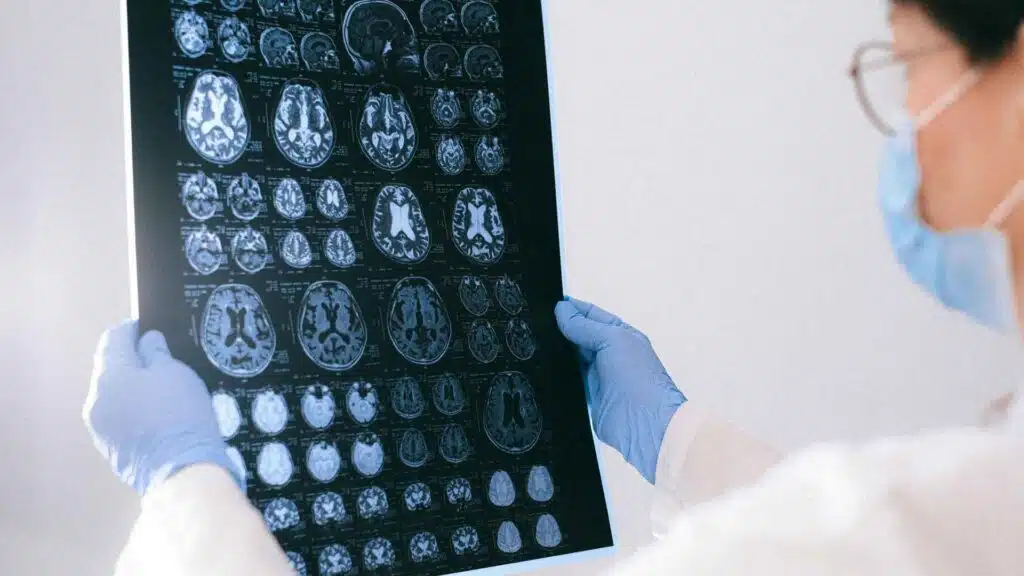
Because of this, a high level of suspicion is needed anytime someone has suffered a serious injury to the head or neck. Doctors typically confirm the diagnosis using imaging scans, such as CT scans and MRIs, to see exactly where the damage is located in the brainstem.
In the documented case described above, treatment included:
Over the following months, this patient made significant progress. He regained enough movement to assist with transfers, his breathing tube was removed, and his swallowing improved to the point that he could eat regular food again. By the time he left the hospital, he could walk with a cane.
If a delayed diagnosis led to permanent harm, you may be entitled to compensation. Speak with our legal team today.
Start My Free Case Review
Not every case of TBI-related LIS looks the same, and outcomes can vary widely. A few patterns have been observed:
Beyond the medical and emotional toll, TBI-related LIS carries a financial burden that most families are not prepared for. A few of the largest cost categories include:
Because LIS often requires this level of care indefinitely, the lifetime cost for a single patient can reach into the millions of dollars. Families are often blindsided by how quickly these expenses accumulate, especially in the first year.
And the costs differ depending on where you live. For example, the median monthly cost for a semi-private nursing home room in the United States in 2025 was $9,581. The same room cost $27,831 in Alaska and $8,334 in Alabama, according to Genworth. These costs can also differ within each state, depending on availability and the cost of living in that area.
If someone else’s negligence or wrongdoing played a role in the traumatic event that led to your TBI, such as a car accident, a fall on unsafe property, a workplace incident, an assault, medical negligence, or a defective product, you or your family may have grounds for a legal claim. A successful case could help recover compensation for medical bills, long-term care costs, lost income, and other damages tied to the injury.
Every situation is different, and whether a claim is viable depends on the specific facts involved. We can help you review what happened and talk through your options with no obligation. This could involve reviewing medical care your loved one received or determining who caused a car crash. If it turns out you have a case, we can help you take the next steps. If you’re not sure where things stand, reaching out to walk through the details costs you nothing but a conversation.
Because TBI often strikes without warning, families describe the experience as watching the ground give way beneath them. There is no time to prepare, and often disbelief that a single moment can change everything.
Despite the sudden nature of TBI, families facing this type of LIS walk a similar road to those facing stroke-related LIS. Communication, coordinated care, and adaptation become central to daily life. Recognizing this shared experience can help families connect with the right resources and support systems as they move forward.
The locked-in syndrome attorneys at Newsome Law are here to help whenever you are ready. And remember, the consultation is free, and you only pay us if we recover for you.
What is Second Impact Syndrome? Loss of consciousness after the initial injury followed by secondary brain damage creates ionic fluxes,...
Imagine going to the hospital because your sodium levels are dangerously low. Doctors fix it fast, but the treatment itself...

Factors That Affect Life Expectancy There are several factors that can impact the life expectancy of a person with LIS,...

Locked-in syndrome is one of the most devastating neurological conditions a person can experience. Patients retain full cognitive function but...

A compassionate guide for caregivers who need care, too Cecelia Williams wrote The 7-Day Reset for Caregivers Who’ve Lost Themselves...

Question: In the spring of last year, I received a brain injury in auto accident. Within a month I hired...

What is Second Impact Syndrome? In patients who sustains a second concussion when the first one has not fully healed,...

A tracheostomy and a ventilator can feel like foreign objects at first: tubes, machines, and sounds that take over a...